
What is a Dynamometer?
Complete Guide to Quality Control Equipment for Containers
Introduction
A dynamometer is a measuring instrument designed to evaluate the mechanical resistance of materials, containers, and products. This equipment applies compression or tensile forces and quantifies the resistance the material offers before deforming or failing. Dynamometers are essential tools in quality control laboratories, especially in the packaging, beverage, and manufacturing industries.
The dynamometer operates through a load cell, which is a transducer capable of converting mechanical forces into measurable electrical signals. This technology allows manufacturers to ensure their products meet specific resistance standards.
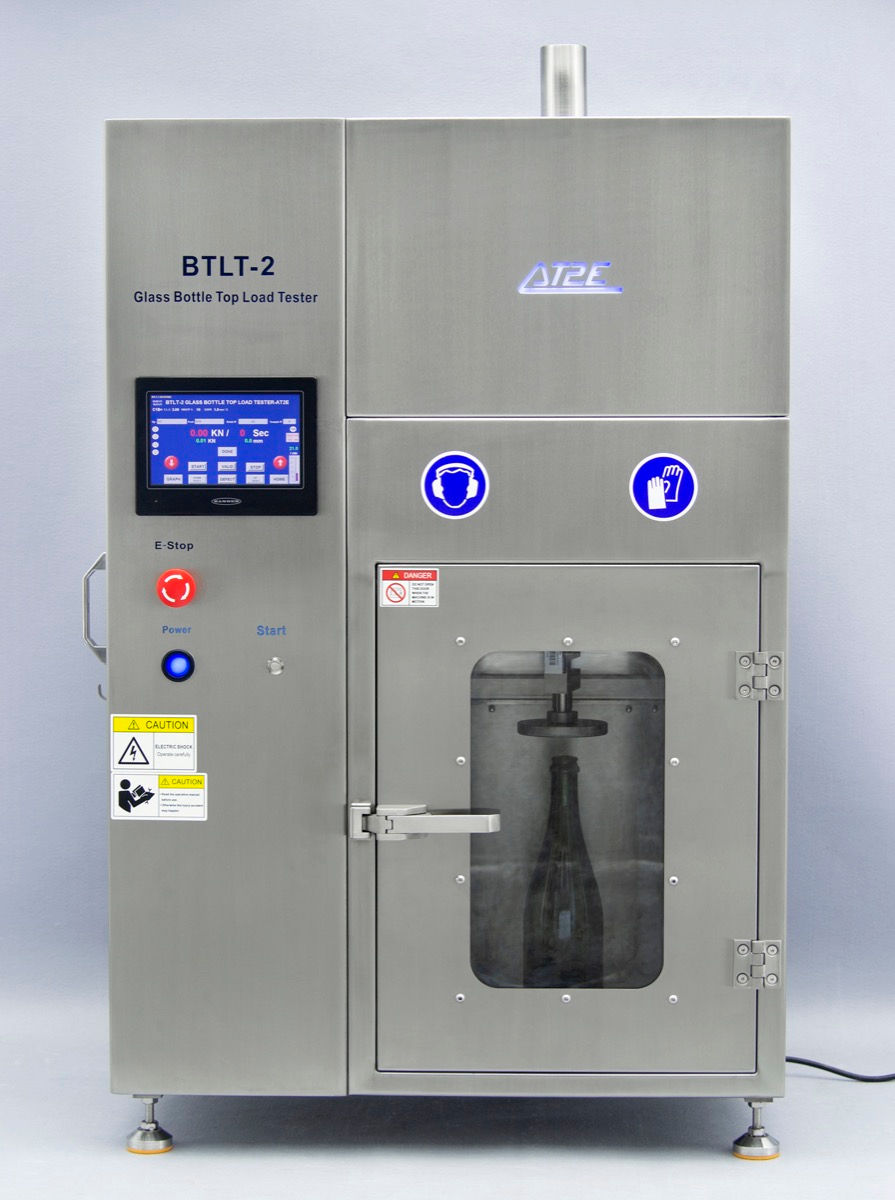
How Does a Dynamometer Work?
Compression and tension equipment operates with a dynamometer and a motor. The motor applies the tensile or compressive force to the container being evaluated, while the dynamometer measures that force, allowing detection of the deformation produced by the applied force.
Compression: Measures how much force a material can withstand before deforming or collapsing (e.g., crushing a bottle).
Tension: Measures the resistance to separation of components (e.g., removing a cork from a bottle).
The load cell is the key component of the dynamometer. It acts as a transducer that converts the mechanical deformation of the load cell into a voltage or electrical current. This signal is processed through an electronic controller that displays both the complete resistance curve and the maximum (peak) force value the material was able to withstand.
Main Applications
Dynamometers are used across multiple industries to ensure quality:
Beverage industry: Compression resistance testing for glass and plastic (PET) bottles.
Caps and corks: Measurement of the force required to remove caps or corks from bottles.
Toothpaste tubes: Evaluation of heat seals and laminate resistance.
Cables and cords: Tension testing to determine the resistance of solid or braided materials.
Metal containers: Such as aluminum cans for carbonated beverages or tin cans for preserved foods.
Key Concepts: Precision vs. Resolution
It is essential to understand the difference between two terms that customers often confuse:
Precision: The ability of an instrument to give repeatable readings. A dynamometer is precise if it measures the same value multiple times under the same conditions.
Resolution: The ability to distinguish between very close values. A higher measurement range generally implies lower resolution.
This inverse relationship is critical: a 500 kg dynamometer cannot detect variations below 1 kg, just as a 30 cm ruler cannot easily make measurements below 1 millimeter.
The Elastic Phase of Materials
All materials have an elastic phase: the period during which they can deform but recover their original shape when the force is removed. Once this elastic limit is exceeded, the material undergoes permanent deformation or failure.
For example, a rubber band can stretch and return to its shape, but if stretched too far, it breaks. Concrete has an almost imperceptible elastic phase, while plastic has a more evident one. The dynamometer measures exactly how much force is needed to exceed this elastic phase and cause failure.
Dynamometer Calibration
Dynamometer calibration is performed using another dynamometer as a reference standard. The process, called "direct comparison calibration", consists of:
Placing a reference load cell (of known value) in contact with the cell of the equipment being calibrated.
Applying incremental forces and comparing the readings of both cells.
Recording errors and uncertainty to generate a calibration certificate.
When a dynamometer shows an error greater than the tolerable limit, the cell is not replaced — instead, the conversion factor in the control software is adjusted. However, if the error exceeds certain limits even after adjustment, the cell must be replaced.
Types of Dynamometers and Customization
Specialized manufacturers such as AT2E offer dynamometers with different capacity ranges:
Standard models: Designed for 3-liter bottles but adaptable to different sizes via interchangeable bases.
High-capacity models (Dyna 4000): For compressions of 500 kg or more, including metal cans and large water jugs.
Universal models (TCT): Versatile for tension and compression, with multiple accessories (clamps, corkscrews, etc.).
The operation is semi-automatic: the operator positions the sample and activates the test via manual or automatic controls. The machine executes the movement and records the deformation or rupture resistance data.
Conclusion
The dynamometer is an indispensable tool for ensuring the quality and safety of packaged products. By understanding its operation, the concepts of precision and resolution, and the importance of regular calibration, companies can make informed decisions about their testing equipment. Selecting the right dynamometer based on the required capacity range and resolution ensures reliable and consistent results in quality control.