
How to Perform Tensile Testing
What a dynamometer is, how the load cell works, and what you need to correctly test a material's resistance.
What Is a Dynamometer and What Is It Used For?
A dynamometer is the equipment that measures how much force is required to deform, separate, or break a material or component. That force can be applied in two ways: tension (also called tensile force, which stretches or pulls the material) or compression (which crushes it). Tension and traction refer to the same concept: stretching a material to evaluate its resistance.
In practice, these tests are used to evaluate everything from the resistance of a PET or glass bottle, to the force needed to remove a cork from a wine bottle, separate the cap from a toothpaste tube, or test the tensile strength of a cable or thread.
The Core of the Equipment: The Load Cell
The central component of any dynamometer is the load cell, which functions as a transducer: it converts the mechanical stress it receives (compression or tension force) into an electrical signal, either voltage or current. Physically, the load cell is typically S-shaped, and it directly receives the stress from the material being tested.
As the material begins to yield, the load cell detects how the resistance force changes and records that behavior as a complete curve, although the equipment typically reports the peak value: the maximum force reached before the material fails.
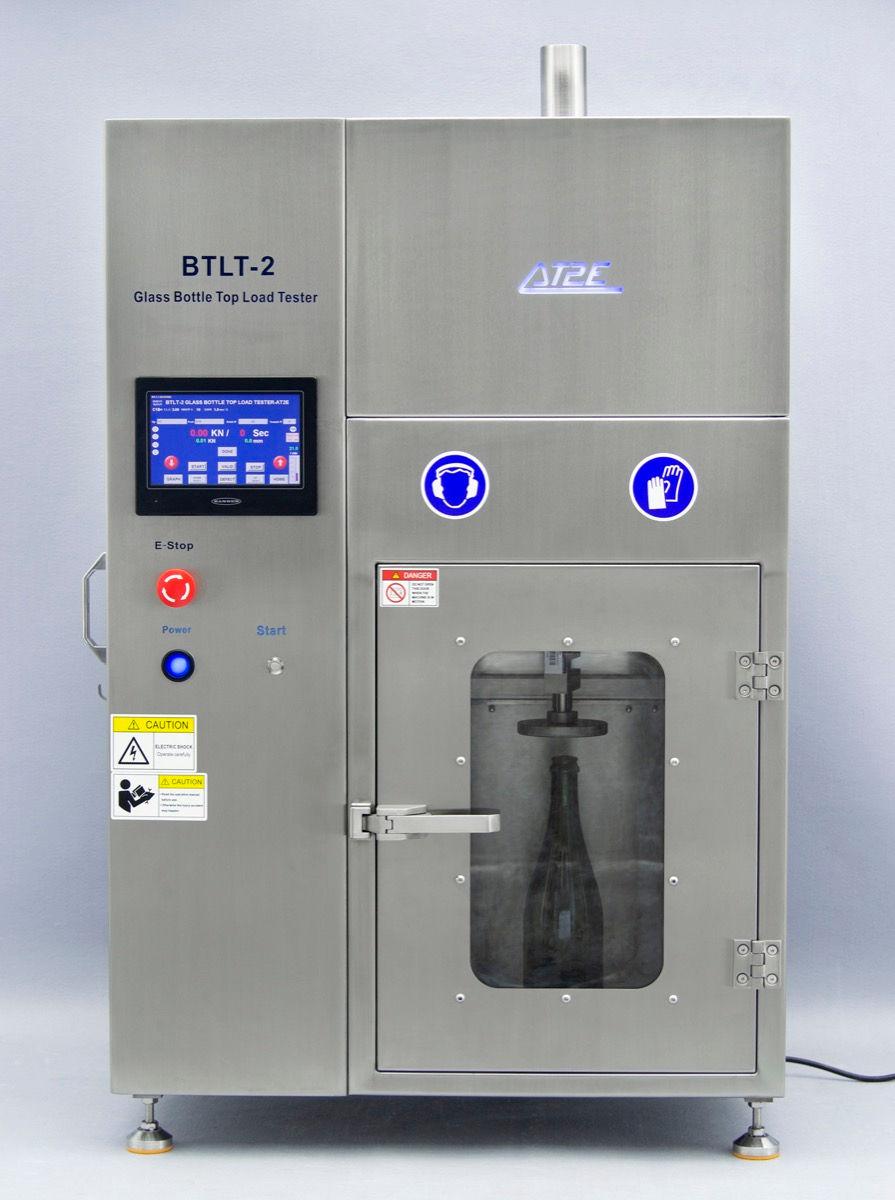
BTLT-2 glass bottle top load tester: the load cell sits inside an enclosed cabinet for glass testing.
How the Test Is Performed, Step by Step
The container or material is mounted on a base specific to its size, since the equipment's compression stroke is fixed (around five centimeters).
The right accessory is selected: grips for tension based on the material's shape (thread, cable, tab), or simply the base for compression.
The equipment is semi-automatic: the operator manually brings the head close, and the motor executes the test cycle in a controlled way.
The load cell reports negative values under compression and positive under tension, recording the full force curve, though the main reported figure is the peak reached before the material yields.
Test Specimens
For tensile testing on plastics, specimens are used: pieces with a narrow neck and wider ends for the grip, molded from samples of the material, allowing quality evaluation before production starts. A specimen can also be cut directly from an already-manufactured container. For concrete, cylindrical specimens are compressed to evaluate resistance before use in construction such as bridges.
The Elastic Phase of Materials
Every material has an elastic phase: a range in which it deforms under force but returns to its original shape once the force is removed, like a rubber band. This can be nearly imperceptible, even in rigid materials like concrete, where it's measured in microns. Plastic has a much wider elastic phase than glass or concrete, allowing it to compress more before failing.
Range, Accuracy, and Resolution
The typical minimum capacity is 10 kg, since the operating principle is identical regardless of the load cell's capacity. There is a direct relationship between range and resolution: higher capacity means lower resolution for detecting small force variations, so capacity should match the actual material being tested rather than oversizing the equipment.
Two often-confused concepts: accuracy means the equipment measures consistently (repeatability), and resolution is the ability to distinguish between two close values. If higher resolution is needed, there's no need to buy a new machine — simply swap the load cell, an interchangeable module.
Typical minimum capacity | 10 kg |
Test type | Tensile (tension) and compression, on the same machine |
Compression stroke | Approximately 5 cm |
Interchangeable component | Load cell (selected by required capacity and resolution) |
Operation mode | Semi-automatic: manual positioning, motorized test cycle |
Calibrating the Dynamometer
Calibration is performed by direct comparison: a reference load cell of known value is mounted alongside the equipment's load cell, both are compressed simultaneously, and the readings are compared to verify whether the equipment measures correctly.
If the error is small, it's corrected by adjusting the conversion factor in the software, without touching the hardware. If the error grows, calibration frequency is increased (from annual to semi-annual, then to quarterly). When the error persists even with frequent calibration, the load cell has reached the end of its useful life and must be replaced.